Estados Unidos

Guatemala Moving Forward
What the cable car to be built in Sololá will look like, connecting hotels with hiking trails and overlooks
A tourism project is planned around Lake Atitlán that includes the cable car, a hotel zone, a linear park, and a small hydroelectric plant. It is proposed as a public-private partnership with an estimated investment of US$22 million.

|

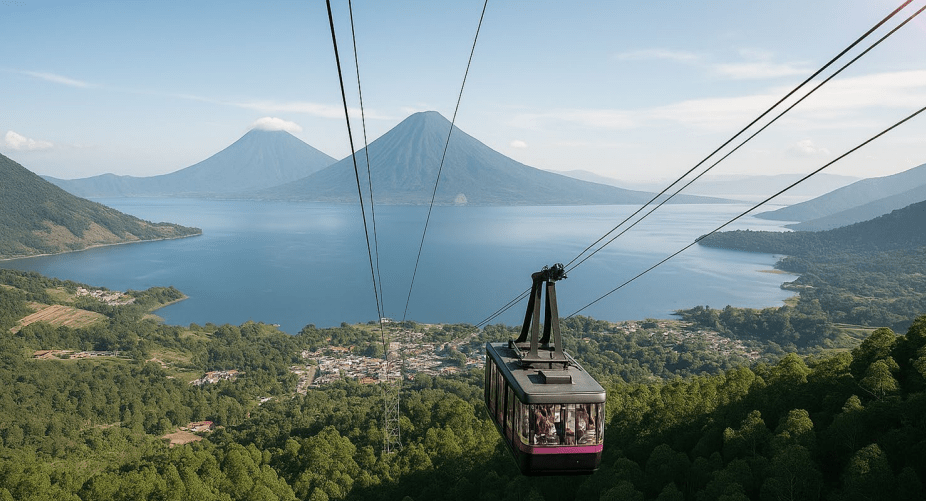
Plans are underway to build a tourist cable car in the Municipium of Sololá. This is a rendering of what it would look like. (Photo: Prensa Libre/ANI)
A cable car, a hotel zone, a linear park, and a small hydroelectric plant are some of the projects that make up the Jaibal Atitlán Tourism Complex, a project that could be implemented as a public-private partnership (APP) [for its acronym in Spanish] through the National Infrastructure Agency (ANI) in the municipality of Sololá.
The cable car would connect trails, lookout points, and natural areas, positioning Ciudad Jaibal as a sustainable tourist destination in the Atitlán basin. It would have six main stations, four planned lines, and a total length of 5.6 kilometers; the ride would take 15 minutes. The project’s development would cost approximately US$22 million.
The first project they plan to implement is the tourist cable car. According to Sololá Mayor Andrés Lisandro Iboy, this would connect the main tourist attractions. “It would link the key tourist sites, allowing visitors to fully appreciate nature, our forests, our beaches, and, of course, the stunning reflection of beautiful Lake Atitlán and its volcanoes, which are a natural wonder,” he said.
He also added that this project would serve as the centerpiece of a world-class tourism initiative. “What we’re aiming for is the launch of four key hubs where we can integrate this air transport initiative and successfully cater to both domestic and international tourists,” he said.
According to Iboy, Finca El Jaibal, where this tourism project is planned, covers five caballerías [a caballería is a historical unit of agricultural land, commonly used in Latin America, which varies by country] —that is, approximately 244 hectares. “This area is unique because we have more than a kilometer of public beach along almost the entire shoreline,” he said.
According to the mayor, this project was conceived with the aim of curbing the migration of residents to the United States. “There are no opportunities. Young people who manage to graduate from high school don’t have any prospects; instead, they pack their bags in search of the American dream,” he said.
He also added that he aims to create opportunities for the local residents and make the most of the area’s natural resources. “It’s about creating opportunities for our people, for our young people, and above all, we have that natural beauty—the landscape of Lake Atitlán—which is one of Guatemala’s greatest wonders,” he explained.
Iboy confirmed that the scale of the project led them to seek a partnership with the ANI to carry it out through an APP, since the municipality lacks sufficient resources. “But it has to be through a major partnership, because it would be impossible for the municipality alone to develop this kind of large-scale project with the resources it has,” he said.
According to Luis Rey, president of the Chamber of Tourism’s Advisory Council, these projects represent an excellent opportunity to develop sustainable products. “We believe it is very important that clear rules be established, both by the central and municipal governments. It is also important to work with the community, because it is crucial for governance to have a good relationship with the community in order to provide jobs and give them the opportunity to present projects within the community so that people can also learn more about the destination,” he emphasized.
According to José Ardón, executive director of the Guatemalan Chamber of Commerce, the country has enormous tourism potential that has not been fully tapped due to a lack of infrastructure related to transportation, tourism services, and energy—all of which are necessary for the development of tourist hubs.
“We need a national strategy focused on tourism development. Public-private partnerships are extremely valuable tools because they help accelerate investment in strategic infrastructure in areas where financial resources may be scarce or implementation capacity is insufficient,” he said.
A Master Plan
The mayor explained that the project is part of a broader land-use planning initiative called Ciudad Jaibal, which aims to integrate various tourism and urban development projects. “The goal is to begin working with a master plan. Our objective is economic development, competitiveness, and sustainable tourism,” he said.
According to Iboy, the plan includes urban planning that will help guide the area’s growth. “When talking about a city like Jaibal, you need to have all the technical foundations in place to be able to develop it. What we’re looking for is a purpose-driven vision for urban development,” he said.
The mayor added that the proposal aims to make use of the area’s natural resources and promote new economic opportunities for the local population. “Today, many young people are leaving for the United States or Canada because they can’t find opportunities here. The goal of these projects is to create jobs and foster development in the Municipium,” he said.
Rey added that Lake Atitlán is one of Guatemala’s most important attractions, which could present an opportunity to attract new tourists. “Tourists today are looking for destinations and places that are sustainable,” he said.
The Camtur representative emphasized that Lake Atitlán is one of the country’s main tourist attractions and that projects of this kind could help diversify the destination’s offerings.
“Tourists today are looking for destinations and places that are sustainable,” he said.
He added that installing a cable car could offer visitors a unique experience. “Installing a cable car is a project that goes beyond what has typically been done in Guatemala. It can give tourists the opportunity to have a unique and sustainable experience,” he explained.
He also noted that initiatives of this scale could encourage new investment in the sector. “It could serve as a catalyst for more investors to develop similar projects in other major destinations across the country,” he said.
Upcoming Projects
The mayor explained that the master plan includes several projects aimed at harnessing the area’s natural resources. One of these is the construction of a small hydroelectric plant that would utilize the flow of one of the rivers feeding Lake Atitlán.
“We have the Quiscab River channel, one of the most important and water-rich rivers feeding the lake. The first proposal is to generate clean energy—that is, a hydroelectric plant capable of meeting the energy needs of the tourist complex,” he explained.
Another proposal is the construction of a linear park along the river, with the aim of creating recreational areas and trails. “A large linear park is proposed along the riverbank, making use of the natural space for recreational activities,” he said.
In addition, the plan calls for the development of tourism and cultural infrastructure, including hotel districts, dining areas, and spaces dedicated to promoting local culture. “The culinary aspect is also important for introducing visitors to traditional dishes and local culture,” the mayor noted.
According to Iboy, the scale of these projects requires significant investment, which is why the municipality sought a joint financing arrangement. “When we talk about a hydroelectric plant, a linear park, a cable car, or a hotel district, we’re talking about major investment projects, and the municipality doesn’t have the resources to cover that,” he said.
For that reason, he explained, the decision was made to structure the project as a public-private partnership. “The goal is to pool resources to develop sustainable projects and boost tourism in this region of the country’s highlands,” he said.
Next Steps
The mayor explained that the next step is to move forward with the technical planning of the project and to establish the partnerships necessary for its development. According to Iboy, the goal is for the project to be built on a well-organized plan that allows for the integration of various tourism and urban components. “It’s not just about laying out streets or avenues. What we’re looking for is a well-organized plan so we can launch different projects,” he explained.
The mayor noted that the municipality will also need to establish the contractual mechanisms that will allow for the participation of private investors. “These are projects on too large a scale, and we need partners who share our goals,” he said.
He added that one of the challenges will be to determine the type of contract that will ensure the project’s continuity, given that municipal administrations change every four years. “If it’s a larger investment, we would have to use a usufruct arrangement so that the private sector has legal certainty to invest,” he explained.
For his part, Rey noted that clear conditions for investors are essential to attracting investment. “It is very important to have clear rules. Municipalities must have land-use plans and basic infrastructure in place to support investment so that projects remain
Ardón added that there must be legal certainty and a commitment on the part of the government—in this case, the municipality—to carry out the public-private partnership. He also mentioned the importance of ensuring that the projects are communicated to the public. “People need to see the benefits; they need to understand why the project is being undertaken, rather than just viewing it as a project that will benefit a particular company. People need to understand that these are projects that create more jobs, provide more opportunities, and improve people’s quality of life,” he explained.
WRITTEN BY