Estados Unidos

Guatemala Moving Forward
Wiring harnesses, dashboards, and interiors: the auto parts Guatemala could manufacture
The country has the potential to become part of the auto parts supply chain. However industry sectors are calling for improvements to infrastructure, a reduction in red tape and workforce training to accelerate investment.

|


At the Intecap campus in Santa Lucía Cotzumalguapa (Escuintla), there are already programs to train experts and technicians specializing in the automotive field. (Photo: Prensa Libre: Erick Ávila).
Guatemala is beginning to position itself as a strategic country for joining the global auto parts supply chain, particularly in labor-intensive processes and sophisticated manufacturing.
According to Enrique Font, chairman of the Board of Directors of the Guatemalan Chamber of Industry (CIG), the automotive industry is seeking markets with resilience and stability. “Guatemala has all the potential to attract investment in auto parts,” he said.
Although the country lacks the capacity to assemble vehicles, according to studies conducted by Invest Guatemala, it could enter this sector through segments linked to industries already established within the country.
These include the manufacture of wiring harnesses, sensors and electrical cable assemblies; plastic parts, such as dashboards and bumpers; rubber components, including gaskets and hoses; as well as textile interiors which include upholstery, airbags and seat belts.
For Font, the opportunities are not limited to those four segments. “There are lightweight metal components used by the automotive, textile and electrical assembly industries; as well as specialized packaging that is already manufactured in Guatemala and can be assembled in the country,” he said.
According to Font, one of the country´s advantages is that several of the required industrial capabilities already exist and can be adapted to the needs of the automotive industry.
“The country´s competitive advantage is that it is not starting from scratch in manufacturing; rather, there are already industries operating in Guatemala-such as the textile industry- that can adapt to the automotive industry”.
Fredy Palma, CEO of Puerto del Istmo, noted that the analyses conducted by Invest Guatemala reveal opportunities to produce a wide range of auto parts. “They have invested many man-hours and significant resources to assess the potential we have as a country,” he said.
Although he believes that establishing a vehicle assembly plant is not yet among the most immediate opportunities, he does see potential in various segments of the supply chain.
“The idea of a vehicle assembly plant is still a bit far off, but any part of this auto parts division can be manufactured. We are talking about rearview mirrors, seats, electrical systems, lighting, lamps, and tires; any individual vehicle component,” he explained.
Palma believes that Guatemala can leverage its existing strengths in productive sectors to enter the automotive industry. “We have been specialists in textiles for many years. We are among the largest producers of latex and rubber. Plastic injection molding is also important. We are Pioneers in this field”, he said.
According to Palma, the goal is to attract companies that can transform these raw materials and industrial capabilities into vehicle components. “The idea is to create clusters so that the entire ecosystem is located within the same industrial park. The company that makes wiring harnesses, the one that manufactures cables, connectors, or insulation materials can operate close to the others,” he explained.
A New Market
For Font, the country meets conditions that have begun to attract the attention of companies in the automotive sector. “The automotive industry is looking for resilient and stable markets. Guatemala has all the potential to attract investment in auto parts,” he said.
According to Font, one of the main attractions is the availability of labor. “In a global context where there is a shortage of workers, Guatemala has enormous potential. There are about 11 million people in the workforce,” he said.
He added that tariff and financial stability are also among the factors investors consider when evaluating new locations for their operations.
As an example, he mentioned the presence of the Japanese company Yazaki, which manufactures electrical harnesses for vehicles. “If a company has already come to set up operations here, it’s because it sees the potential and the country’s ability to train the workforce,” he said.
Palma believes that Yazaki’s arrival has also served as a benchmark for other companies in the sector. “If a company of this size has established its first plant in Guatemala and plans to expand in the coming years, this confidence opens the door for companies in the same industry to turn their attention to the country,” he said.
According to the director of Puerta del Istmo, efforts have been made in recent years to create the conditions needed to attract this type of investment. “Since 2019, we’ve been working on the idea of promoting and expanding development zones. Regulations were updated, authorities were brought into alignment, and an ecosystem was created for these types of companies,” he explained.
Palma added that industrial infrastructure has also begun to expand to meet future investment demands. “In five years, we’ve built 46,000 square meters of warehouses that are ready for these companies to move in, thereby reducing setup costs and operational lead times,” he said.
He also emphasized that strengthening the workforce and coordinating with institutions such as Intecap are among the elements they aim to offer potential investors. “The infrastructure is being developed so that it will be ready by the time these companies are looking for options to set up operations in Guatemala. The workforce has also improved significantly in terms of training, logistics, and planning,” he said.
Greater Training
The availability of labor is among the factors that sectors involved in attracting investment consider key to the development of an auto parts industry in Guatemala.
According to Font, the country has a large economically active population and institutions that can adapt to the needs of new industries. Among them, he mentioned the Technical Institute for Training and Productivity (Intecap). “It can train the entire workforce, which today may not have experience in auto parts manufacturing but does have experience in other manufacturing processes,” he said.
The CIG president noted that each year, around 250,000 people enter the labor market and that there are several urban centers with more than 100,000 residents that could become sources of recruitment. “Intecap has nationwide coverage, so we are ready to welcome more investment,” he said.
Palma agreed that human resources represent one of the country’s main assets for attracting companies in the sector. “Intecap already includes the development of human talent for these types of industries among its strategic priorities,” he said.
As an example, he cited the Yazaki facility set to open in 2023. “Within four months, the first group of employees—comprising some 400 workers—was ready to begin operations,” he said.
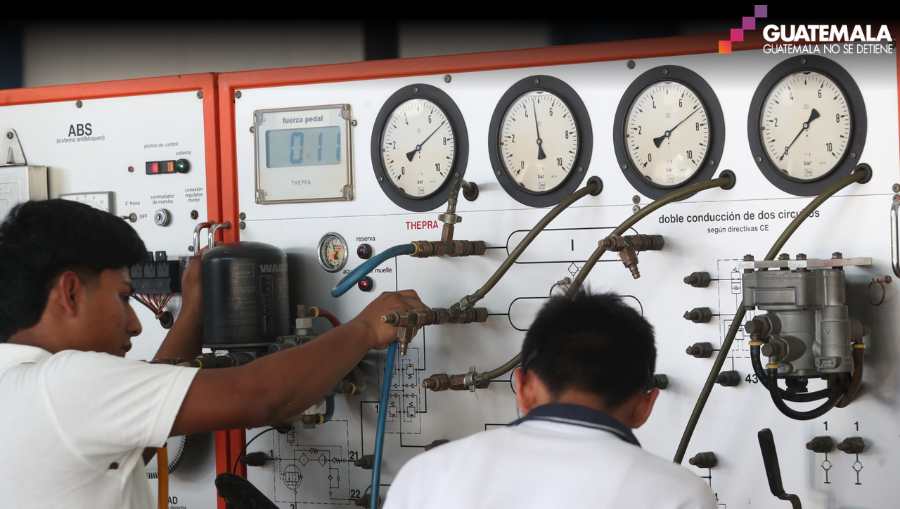
Palma noted that the availability of workers continues to be one of the issues most frequently raised by companies interested in setting up operations in Guatemala. “We have enough talent here to support not just two or three, but many companies in this sector,” he said.
In addition to Intecap, Palma believes that universities could play an important role in training technicians, specialists, and engineers for the industry. “What we need is to involve the education sector so that it can establish training centers near these development hubs and industrial parks,” he explained.
The director of Puerta del Istmo noted that San Marcos has a database of more than 10 thousand people who already possess knowledge related to mechanics, electro-mechanics, vehicle repair, and other technical processes. “All these auto parts manufacturing processes are no longer unfamiliar to these people,” he said.
He added that they are currently in discussions with Intecap to secure spaces that will allow for expanded technical training near the industrial parks. “We want there to be a connection between the training facilities and the needs of the companies that come to operate here,” he said.
Palma added that companies are also evaluating the quality of the available workforce. “It’s no longer about cheap labor, but rather a skilled, professional workforce that is available for these types of processes,” he stated.
As he explained, some companies have shown interest in hiring women due to the nature of certain operations related to auto parts manufacturing. “This sector requires the hiring of many women for these types of industries,” he said.
What's needed?
Although experts believe that Guatemala has made progress in creating conditions to attract investment, they point out that there are still areas that need to be strengthened to consolidate the country’s position within the region’s automotive supply chain.
For Font, one of the main challenges is to boost Guatemala’s international standing as a manufacturing destination. “What’s needed is to position Guatemala as a key hub for accessing those nearby markets,” he said.
According to the businessman, the trend of companies relocating opens up opportunities for countries near the United States and Mexico. “They’re looking for alternatives—the nearshoring that exists today, the country’s resilience, and Intecap’s existing capacity to train technicians quickly,” he said.
Font believes the goal should be to position Guatemala as a hub for automotive manufacturing. “It’s important to position Guatemala as a strategic center for developing manufacturing in the automotive sector,” he said.
Palma identified areas that, in his view, require attention to facilitate the influx of new investments related to auto parts. The first is logistics infrastructure. “We have to understand that everything is part of an ecosystem. Roads are important, as is developing and improving port infrastructure,” he explained.
He added that energy availability is also among the factors evaluated by companies. “We have to invest in energy infrastructure because these types of companies need high-quality, affordable energy,” he stated.
The second challenge relates to streamlining administrative procedures. “We have to make processes agile and straightforward so that these companies can complete the procedures for establishing business entities, as well as the steps for obtaining environmental and legal permits, in record time,” he noted.
Intecap’s Efforts
Training technical personnel is one of the key elements needed for Guatemala to integrate into the auto parts supply chain. In this context, Intecap already offers programs related to fields that could serve as a foundation for this industry.
According to Carlos Emilio Orellana, laboratory director at Intecap Santa Lucía in Escuintla, that center has trained approximately 2,500 people in the various degree programs and courses it offers.
The academic offerings include programs related to mechanics and industrial maintenance. “We offer automotive mechanics, diesel mechanics, combine harvester mechanics, and motorcycle mechanics,” Orellana explained.
According to the official, the school’s ties to the private sector allow some students to enter the job market before completing their training. “The agribusinesses in the area come looking for our students. Most of them leave with internships, and a large percentage end up staying on to work,” he said.
Orellana also noted that the center has begun to adapt to the technological changes taking place in the automotive industry. As part of that process, it has a hybrid vehicle used to train specialized personnel. “We have trained around 200 technicians in this new field,” he said.
According to the lab director, the experience gained in technical training and the presence of assembly operations in the country could facilitate a potential foray into the manufacture of automotive components. “The investment can be made. We already have motorcycle assembly plants and serve as assemblers for Central America. We can do the same with cars; we have the capacity,” he said.
Among the degree programs and specializations related to the automotive sector offered by Intecap are:
- Automotive Technician
- Mechanical Design Technician
- Gasoline Automotive Mechanic
- Industrial Maintenance Mechanic
- Motorcycle Mechanic
- Lathe and Milling Machine Operator
- Internal Combustion Engine Grinder and Turner
- Hybrid and Electric Vehicle Maintenance Technician
- Automotive Mechanics Specialist
- Mechatronics Specialist
The Future of the Industry
Despite the challenges mentioned, Palma believes that international companies are interested in evaluating Guatemala as a destination for new operations related to the automotive industry. “There is a lot of interest from these types of industries in Guatemala, in the truck, forklift, motorcycle, and vehicle segments,” he said.
However, he explained that investment decisions typically require lengthy analysis processes. “These companies carefully consider relocating operations from Asia or Mexico to Guatemala because the investments are high and the commitments to the assembly plants are significant as well,” he noted.
He explained that the proximity to that market allows Guatemala to complement part of the Mexican industry’s installed capacity. “Mexico has more demand than supply, and some of those companies are turning their attention to Guatemala,” he said.
Find more from “Guatemala Moving Forward” on our Prensa Libre and Guatevisión video channels, a collaborative content series focused on solutions journalism.
Find more from “Guatemala Moving Forward” on our Prensa Libre and Guatevisión video channels, a collaborative content initiative focused on solutions journalism.
WRITTEN BY